


Divorce and the Family Home: What Marysville Homeowners Need to Know Before Making a Costly Mistake
Divorce is rarely easy. It is an emotional storm that often forces you to make massive financial decisions when you are least equipped to handle them. For many couples in Marysville, the single biggest asset—and the biggest point of contention—is the family home.
Whether you are living in a quiet cul-de-sac in Scott Farms or a two-story traditional in Mill Valley, the house represents more than just equity; it represents stability, memories, and the life you built. But making decisions based on sentiment rather than strategy can lead to financial mistakes that haunt you for years.
If you are navigating a divorce in Union County (ZIPs 43040, 43064), here is what you need to know to protect your credit, your equity, and your peace of mind.
1. Ohio is an "Equitable Distribution" State (Not Always 50/50)
A common misconception is that the house will automatically be split 50/50. Ohio law follows the principle of equitable distribution. This means the court aims to divide marital assets fairly, which doesn’t always mean equally.

The court looks at several factors, including:
- The length of the marriage.
- The liquidity of the property.
- Custody arrangements (the court may favor keeping children in the family home).
- Financial contributions of each spouse.
Local Insight: If you purchased your home in Adena Pointe before you were married, but used marital funds to pay the mortgage or renovate the kitchen, a portion of that equity may now be considered marital property. Untangling "who owns what" requires clear documentation.
2. The Three Paths Forward
Generally, you have three options for the home. Each comes with specific challenges in the current Marysville market.
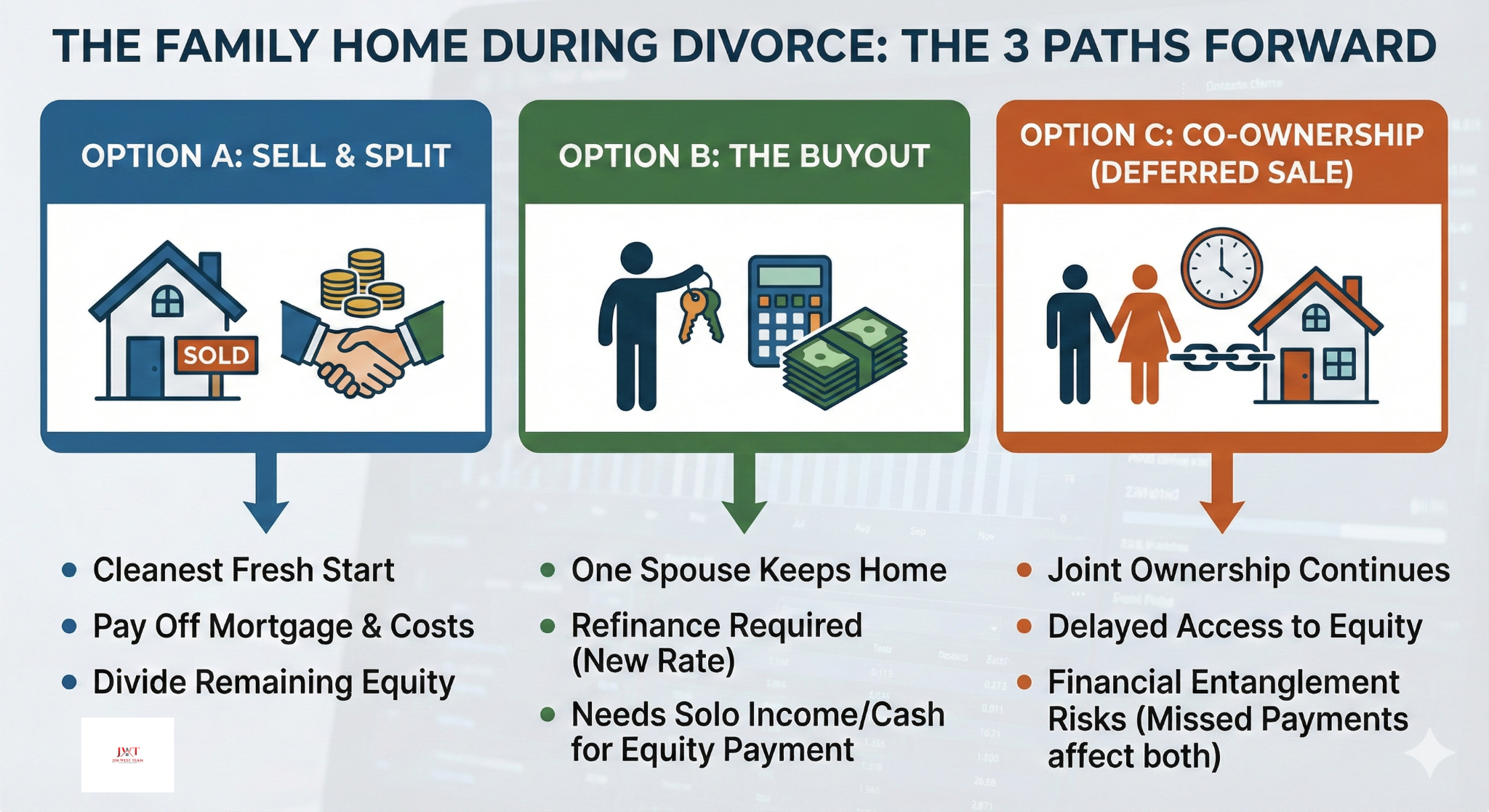
Option A: Sell the Home and Split the Proceeds
This is often the cleanest "fresh start." You sell the home, pay off the mortgage and selling costs, and divide the remaining equity.
The Marysville Market Reality: While Marysville is still largely a seller’s market, the "frenzy" of recent years has cooled. Inventory is rising. Homes in Green Pastures or Mill Valley are no longer guaranteed to sell in a weekend unless they are priced accurately.
- The Risk: If you overprice the home due to emotional attachment, it may sit on the market, increasing tension between you and your ex-spouse as holding costs (mortgage, utilities) pile up.
Option B: The Buyout
One spouse keeps the house and refinances the mortgage to remove the other spouse’s name and pay them their share of the equity.
The Interest Rate Trap: Many homeowners in Marysville are sitting on interest rates below 4%. Refinancing now could mean trading a 3% rate for a rate significantly higher.
- The Risk: Can the spouse keeping the home afford the new mortgage payment at current rates on a single income? If not, this option can lead to foreclosure down the road.
Option C: Co-Ownership (Deferred Sale)
You agree to keep the house jointly for a set period (usually until children graduate).
The Liability: This keeps your finances entangled. If the spouse living in the house misses a payment, both credit scores suffer.
- The Risk: What happens if the furnace breaks in February? Who pays for the new roof? Without a strict legal agreement, this is a recipe for future conflict.
3. Why "Neutrality" Matters in Your Real Estate Agent
In a divorce listing, the real estate agent typically acts as a neutral third party. This is not a standard sale. You need an agent who understands that they are working for the house, not favoring one spouse over the other.
This is where a Certified Divorce Real Estate Expert (CDRE) is vital. A CDRE is trained to:
- Remain neutral and avoid getting triangled into arguments.
- Provide data-driven valuations to the court (preventing arguments over list price).
- Testify if necessary regarding fair market value.
Jim West, a CDRE serving Marysville, utilizes an engineering background (honed at Honda) to bring a factual, "blueprint" approach to the sale. By focusing on the data—recent comps in Scott Farms, absorption rates in Green Pastures, and factual repair costs—he helps lower the emotional temperature of the transaction.
4. Don’t Forget the "Hidden" Costs
When calculating equity, many divorcing couples look at the Zillow "Zestimate" and divide by two. This is a mistake. You must calculate the Net Proceeds, which include:
- Outstanding mortgage payoff.
- Realtor fees and closing costs.
- Capital Gains Tax: If the home has appreciated significantly (common in Marysville recently), there may be tax implications if you sell.
- Repairs: Will the house pass an FHA inspection? If not, who pays for the repairs required to sell?
FAQ: Divorce and Real Estate in Ohio
Q: Can I sell the house before the divorce is final?
A: Yes, but both spouses must agree, and the court usually issues a temporary restraining order on assets preventing one party from selling without consent. Proceeds are typically held in escrow until the final decree determines how they are split.
Q: Who moves out during the divorce?
A: Legally, neither spouse is required to move out unless there is a court order (often due to domestic violence). However, once one spouse moves out, it can sometimes affect their claim to "possession" of the home during the proceedings, though not necessarily their financial equity.
Q: How is the house value determined?
A: The court will not rely on online estimates. You will likely need a professional appraisal or a comprehensive Comparative Market Analysis (CMA) from a neutral real estate expert.
Q: What if my spouse refuses to sell?
A: If the parties cannot agree, the court has the power to order the sale of the home to ensure equitable distribution of assets.
A Soft Landing for a Hard Transition

Divorce is a legal process, but selling your home is a business transaction. You cannot afford to let emotions dictate the price or the terms.
Whether you are looking to sell a large family estate in Green Pastures or a starter home near the city center, you need a strategy that protects your financial future.
Jim West is not just a local Realtor; he is a Certified Divorce Real Estate Expert with the specialized training to handle high-conflict sales with discretion and neutrality.
To understand the difference between divorce real estate designations and what to look for when hiring an agent, read this article
Need a confidential conversation about your property?
Contact Jim West today to discuss your options and ensure your home equity is protected.
(614) 507-5732 | jimwest@jimwestteam.com