
How Much Are Closing Costs in Ohio?
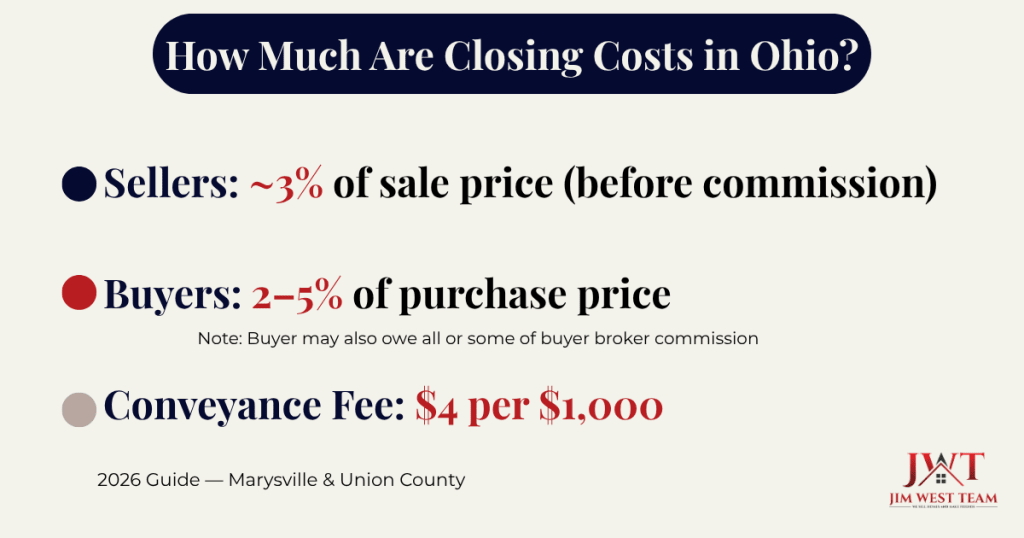
How much are closing costs in Ohio? Buyers typically pay 2% to 5% of the purchase price. Sellers should plan for about 3% of the sale price on top of agent commission, and in Union County the conveyance fee is $4 per $1,000.
On a $350,000 home in Union County, that means buyers should budget $7,000 to $17,500 and sellers should plan on roughly $10,500, before commission.
Closing costs are one of the most common blind spots I see with both buyers and sellers in Marysville, Ohio and throughout Union County. Sellers focus on commission and forget the other costs coming off their proceeds. Buyers budget for their down payment and then scramble when the lender's Closing Disclosure shows another $10,000 or more in fees they didn't plan for.
This guide breaks down what closing costs look like in Ohio in 2026, who is typically responsible for each line item, which costs are fixed by law and which you can negotiate, and what the numbers look like at price points common in the Marysville and Union County market. Prefer to watch? Here is the video version.
What Are Closing Costs?
Closing costs are the fees, taxes, and charges that both parties pay when ownership of a property officially transfers from seller to buyer. They're separate from the purchase price and from agent commission. Some are fixed by the county or state, some are lender-required, and some are negotiable between buyer and seller.
In Ohio, these costs are governed by a combination of state law, including Ohio Revised Code § 319.54 and § 322.02 for the conveyance fee, and local county practice. Who pays what follows established custom, and the purchase agreement makes the final call.
Ohio Closing Costs for Sellers
Ohio sellers should plan for about 3% of the sale price in closing costs, not counting agent commission. Treat that as a conservative budgeting number. The fixed fees below (conveyance fee, title, settlement, and recording) usually add up to closer to 1% of the sale price. The rest of the planning figure covers your property tax proration, any concessions you agree to, and payoff-related items that vary from seller to seller. Here is what goes into it:
Conveyance fee (transfer tax): Ohio calls its transfer tax a "conveyance fee." The state charges $1 per $1,000 of the sale price, and counties can add up to $3 per $1,000. Union County's rate is $4 per $1,000. On a $350,000 sale in Marysville, your conveyance fee is $1,400 plus a $0.50 per-parcel transfer fee. The seller pays it when the deed is recorded with the county. It is set by law, so you can't negotiate it down or waive it. I explain the conveyance fee at 1:36 in the video.
Title insurance (owner's policy): In central Ohio, the seller customarily pays for the buyer's owner's title insurance policy, which protects the buyer's ownership interest. This typically runs about 0.25% of the sale price. On a $350,000 sale, budget roughly $875.
Title search and settlement fees: The title company charges for the title search, document preparation, and settlement coordination. These fees typically range from $400 to $800, depending on the title company and the complexity of the transaction.
Recording fees: The county charges for recording the deed and any related documents. In Union County, expect $30 to $75 depending on the number of pages.
Prorated property taxes: This is the one that surprises even experienced sellers. Ohio property taxes are paid in arrears, so the bill due in 2026 covers 2025. At closing, you credit the buyer for the taxes that have accrued through your closing date but haven't been billed or paid yet, and that credit comes straight off your proceeds. It is usually larger than sellers expect, and it is different for every parcel. Union County homes sit in several school districts, and school levies drive the tax bill, so two houses at the same price can carry very different annual taxes. Your neighbor's proration is not yours, so pull your own parcel's numbers before you set a list price. I cover the proration trap at 2:01 in the video.
Possible additional seller costs: Mortgage payoff and any associated prepayment penalties, HOA transfer fees if applicable, agreed-upon repair credits or buyer concessions, and a home warranty if offered as part of negotiations.
If the sale is part of a divorce, all of these costs come out of the equity that gets divided between spouses, which is one more reason to run the numbers before anything is listed. My Ohio divorce home sales guide walks through that process.
What About Agent Commission?
Agent commission is the single largest cost for most Ohio sellers, and it is handled separately from closing costs on your settlement statement. It is also negotiable. No law sets the rate and no board mandates a number. It is an agreement between you and the agent you hire, so understand exactly what you are agreeing to before you sign a listing agreement. I break this down at 0:52 in the video.
Total commission in Ohio has commonly run around 5.7% to 5.9% of the sale price, split between the listing agent and the buyer's agent. On a $350,000 sale, that is roughly $20,000 to $20,650. Since the NAR settlement rules took effect in August 2024, compensation offers can no longer be made through the MLS, so buyer agent pay is now negotiated directly.
When you combine the ~3% planning figure for closing costs with commission, total selling expenses generally fall in the 8% to 10% range. For a breakdown specific to Marysville, see our cost to sell a house in Marysville net sheet.
Want to know exactly what you would walk away with if you sold your home today? I'll build you a custom net sheet using your address, your mortgage balance, and your neighborhood's recent comparable sales. Call or text me at (614) 507-5732. No obligation, just real numbers.
Ohio Closing Costs for Buyers
Buyers in Ohio should budget 2% to 5% of the purchase price for closing costs. The range is wide because buyer costs depend heavily on the type of mortgage and the lender's fee structure.
Loan origination fee: Most lenders charge 0.5% to 1% of the loan amount for processing and underwriting the mortgage. On a $280,000 loan, that's $1,400 to $2,800.
Appraisal fee: The lender requires an independent appraisal to confirm the property's value. In Central Ohio, expect $400 to $600.
Home inspection: Not technically a closing cost, since it is usually paid up front, but budget $325 to $450 for a standard inspection in the Union County area.
Title insurance (lender's policy): The buyer pays for the lender's title insurance policy, which protects the lender's interest in the property. It is separate from the owner's policy the seller pays for.
Prepaid interest: You'll pay interest from your closing date through the end of that month, so closing later in the month reduces this charge.
Escrow deposits: Your lender will collect up-front deposits for property taxes and homeowner's insurance to fund your escrow account. This is usually 2 to 3 months of estimated taxes and insurance.
Government-backed loan fees: FHA loans require an upfront mortgage insurance premium of 1.75% of the loan amount. VA loans have a funding fee, typically 1.25% to 3.3% depending on down payment and service history, and some veterans are exempt. USDA loans have a 1% upfront guarantee fee. These can significantly increase buyer closing costs compared to a conventional loan, either as cash at closing or rolled into the loan. I walk through each loan type at 4:08 in the video.
Ohio-specific note: Ohio does not charge a mortgage tax, so buyers avoid an expense that exists in some other states. That's one place Ohio works in your favor. If you're still sorting out financing, our home buyer financing help page is a good place to start.
Who Pays What in an Ohio Closing?
Here is the standard breakdown of who typically pays each cost in an Ohio real estate transaction. Most of it is custom rather than law, so the purchase agreement determines the final split. The exceptions are the fees set by statute, which are marked in the last column.
| Cost Item | Typically Paid By | Negotiable? |
| Conveyance fee (transfer tax) | Seller | No. Set by law ($4 per $1,000 in Union County). |
| Owner's title insurance | Seller, by central Ohio custom | Who pays: yes. The premium itself: no. |
| Lender's title insurance | Buyer | Who pays: yes |
| Title search and settlement | Split or seller | Yes |
| Loan origination fee | Buyer | Shop lenders to compare |
| Appraisal | Buyer | No. Lender-required. |
| Home inspection | Buyer | Not a closing cost. Paid up front. |
| Recording fees | Buyer (deed) / Seller (release) | No. Set by the county. |
| Prorated property taxes | Seller credits buyer for the time the seller owned the home | No. Calculated to the closing date. |
| Escrow deposits (taxes/insurance) | Buyer | No. Lender-required. |
| Agent commission | Each party pays their own agent | Yes |
What Is Negotiable in an Ohio Closing, and What Is Not?
Fixed by law or by the lender, and not negotiable: the conveyance fee, county recording fees, the prorated property tax calculation, and lender-required items like the appraisal and escrow deposits.
Decided in the purchase agreement, and negotiable: who pays for the title search and settlement fee, agent compensation, and whether the seller covers some or all of the buyer's closing costs. That last one is called a seller concession, and it is the biggest negotiating lever for buyers. A buyer asks the seller to credit a set dollar amount toward closing costs, which reduces the cash the buyer needs at the table.
Whether a seller can say no comes down to leverage. The August 2026 Columbus REALTORS report for the Marysville school district (all home types) showed 94 active listings and 2.4 months of supply. That is still well under the roughly six months generally treated as a balanced market, so well-priced homes keep selling. But buyers have more choices than they did earlier this year, and concession requests are showing up more often. Decide how you will respond before an offer lands on your table. See the latest Marysville market update for current numbers, and read how days on market affects pricing to see how much leverage a well-priced listing keeps. I cover concessions and agent compensation at 5:18 in the video.
Real Cost Examples for Union County, Ohio
Here is what closing costs look like at three price points common in the Marysville and Union County market. These are planning estimates. Your actual numbers will depend on your lender, title company, tax proration, and negotiated terms. The seller column uses the ~3% planning figure, which already includes the conveyance fee, and shows commission separately at an illustrative 5.8%. Your commission is whatever you agree to in your listing agreement.
| Sale Price | Union County Conveyance Fee ($4 per $1,000) | Seller Closing Costs (~3%) | Commission (illustrative 5.8%) | Total Seller Costs | Buyer Closing Costs (2-5%) |
| $275,000 | $1,100 | $8,250 | $15,950 | $24,200 | $5,500 to $13,750 |
| $350,000 | $1,400 | $10,500 | $20,300 | $30,800 | $7,000 to $17,500 |
| $450,000 | $1,800 | $13,500 | $26,100 | $39,600 | $9,000 to $22,500 |
These numbers are why I prepare a detailed net sheet for my sellers before we go to market. You need to know what you'll walk away with, not just what the house sells for. If you're selling in Marysville or Union County, I can run these numbers for your specific property, mortgage balance, and situation. Visit our Marysville Seller Playbook for more tools and guides.
How to Reduce Your Closing Costs in Ohio
You can't eliminate closing costs, but you can manage them.
For sellers: Get a net sheet from your agent before you list, not after you have an offer. Understanding your true bottom line up front prevents surprises and helps you price strategically. Compare title company quotes, since settlement fees vary. If you're selling without an agent (FSBO), your closing costs don't disappear. You still owe the conveyance fee, title costs, and prorated taxes. See our Marysville FSBO Guide for a realistic breakdown of what going solo actually costs.
For buyers: Shop your lender. Loan origination fees, discount points, and processing charges vary significantly from one lender to the next, often by $1,000 or more on the same loan amount. Ask every lender for a Loan Estimate, the standardized form required by federal law, and compare them line by line. Close later in the month to reduce prepaid interest. And check whether you qualify for the Ohio Housing Finance Agency (OHFA) Down Payment Assistance program, which can provide 3% to 3.5% of the purchase price toward down payment and closing costs. That assistance is forgiven after seven years.
Frequently Asked Questions
Who pays closing costs in Ohio, the buyer or the seller?
Both parties pay closing costs in Ohio, but they pay different costs. Sellers typically cover the conveyance fee (transfer tax), owner's title insurance, and their share of prorated property taxes. Buyers pay lender-related fees like loan origination, appraisal, escrow deposits, and the lender's title policy. The purchase agreement determines the final split.
How much are closing costs on a $300,000 house in Ohio?
On a $300,000 home in Ohio, sellers can plan on approximately $9,000 in closing costs (about 3% of the sale price, excluding commission). Buyers should budget $6,000 to $15,000 (2% to 5%), depending on their loan type and lender. In Union County, the conveyance fee alone would be $1,200 at the standard $4 per $1,000 rate.
Does Ohio have a transfer tax on real estate?
Yes, though Ohio calls it a "conveyance fee" rather than a transfer tax. The state charges $1 per $1,000 of the sale price, and counties may add up to $3 per $1,000, bringing the typical total to $4 per $1,000. Union County charges the full $4 per $1,000. The seller customarily pays this fee at closing when the deed is recorded with the county auditor.
Are closing costs negotiable in Ohio?
Some are and some are not. The conveyance fee and county recording fees are fixed by law, and lender-required items like the appraisal are not up for negotiation. Who pays for title and settlement fees, seller concessions toward the buyer's costs, and agent compensation are all decided in the purchase agreement and are negotiable.
Can the seller pay the buyer's closing costs in Ohio?
Yes. A seller concession is a credit the seller gives the buyer toward closing costs, and it is written into the purchase agreement. Whether a seller agrees depends on market leverage: sellers with multiple offers can decline or counter with a smaller number, while sellers in a slower market are more likely to say yes. Lenders also cap how much seller credit a buyer can use, depending on the loan type.
Know Your Numbers Before You Make a Move
Whether you're buying your first home in Marysville or selling a property you've owned for 20 years, closing costs are real money that affects your bottom line. The sellers who plan for these costs up front make better pricing decisions. The buyers who budget for them avoid last-minute scrambles.
If you're thinking about buying or selling in Marysville, Ohio or anywhere in Union County, I'm happy to walk you through the actual numbers for your situation. No pressure, just straight answers. Call or text (614) 507-5732 or visit jimwestteam.com.
Jim West
REALTOR® | CDRE · RCS-D · CDS
The Jim West Team at Revolution Realty LLC
Serving Marysville, Ohio (43040) and Union County | (614) 507-5732 | jimwestteam.com
The only real estate agent in Ohio with all three divorce designations.