


What must Marysville FSBOs disclose to buyers under Ohio law?
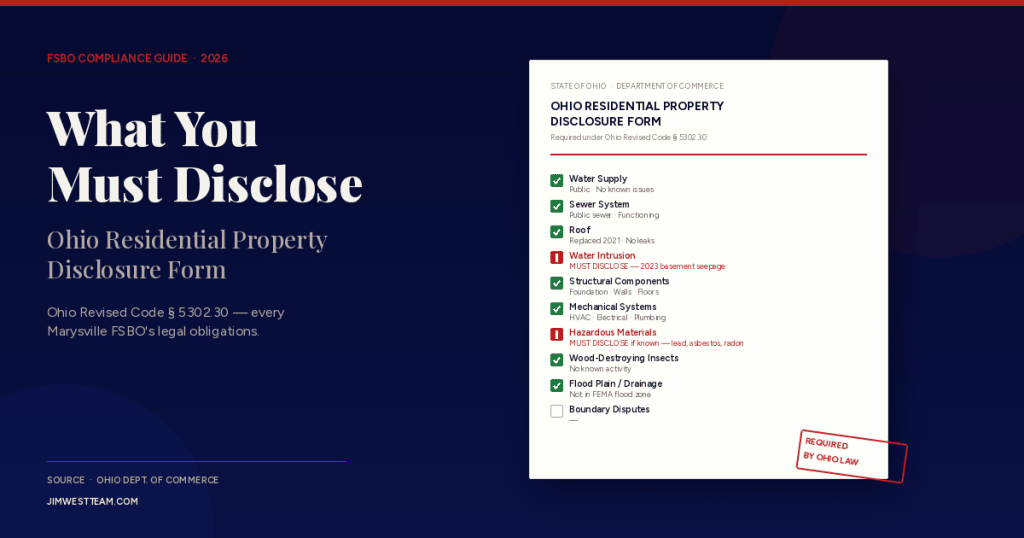
Under Ohio Revised Code § 5302.30, sellers of 1-to-4-unit residential property must complete the Ohio Residential Property Disclosure Form, covering structural, mechanical, environmental, and hazardous conditions they actually know about. Failure to disclose known material defects can give the buyer the right to rescind the sale and pursue damages — even after closing.
Most Marysville FSBOs spend their effort on the listing price. Almost none spend any thought on the document that's far more likely to cause them legal trouble: the Ohio Residential Property Disclosure Form.
That's the one that gets you sued.
Ohio Revised Code § 5302.30 makes the Residential Property Disclosure Form mandatory for almost every Marysville and Union County home sale. The form covers everything from foundation problems to flood damage to lead paint, and it's based on what you actually know — not what an inspector finds. If you knew about a defect and didn't disclose it, the buyer can rescind the sale and pursue damages.
This is one area where doing it yourself as a FSBO carries real risk. Not because you can't do it — you can — but because most FSBOs don't realize how detailed the disclosure obligation actually is, what's exempt, or what happens when they get it wrong.
This post is part of the Marysville FSBO Guide — a free resource library covering pricing, compliance, and documents for Union County sellers going FSBO.
Here's the full compliance picture, in plain English.
The Law in Plain English: ORC § 5302.30
Ohio's mandatory disclosure law has been on the books since 1993 and applies to almost every residential sale in the state. The basic rule:
If you're selling a property with one to four dwelling units in Ohio, you must complete the Residential Property Disclosure Form created by the Ohio Department of Commerce and deliver it to the buyer before they sign the purchase agreement.
The form is based on your actual personal knowledge of the property's condition. You aren't required to hire an inspector to fill it out. You aren't required to investigate things you don't know about. But anything you do know — about a leaky basement, a roof that needs replacing, a previous flood, an electrical issue, a boundary dispute — must be disclosed truthfully.
The current version of the form was last updated in June 2022. You can download it from the Ohio Department of Commerce, Division of Real Estate website.
Who Must Disclose (And Who's Exempt)
Most Marysville home sales require disclosure. The law applies to traditional sales, land installment contracts, leases with an option to purchase, exchanges, and even leases for 99 years or more.
However, Ohio carves out specific exemptions. You generally do not have to provide the disclosure form if your transaction falls into one of these categories:
- Transfers ordered by a court (probate, divorce decree, foreclosure)
- Transfers to or from a government entity
- Transfers resulting from mortgage default (foreclosures, deeds in lieu)
- Transfers made by a guardian, executor, trustee, or fiduciary
- Transfers between co-owners (e.g., one sibling buying out another)
- Transfers between immediate family members
- Sales of newly built homes that have never been occupied
- Properties where the buyer has lived for at least one year as a tenant
If you're not sure whether your situation qualifies for an exemption, get legal advice before skipping the form. The penalty for skipping it when you shouldn't have is much worse than the inconvenience of filling it out.
What the Form Actually Covers
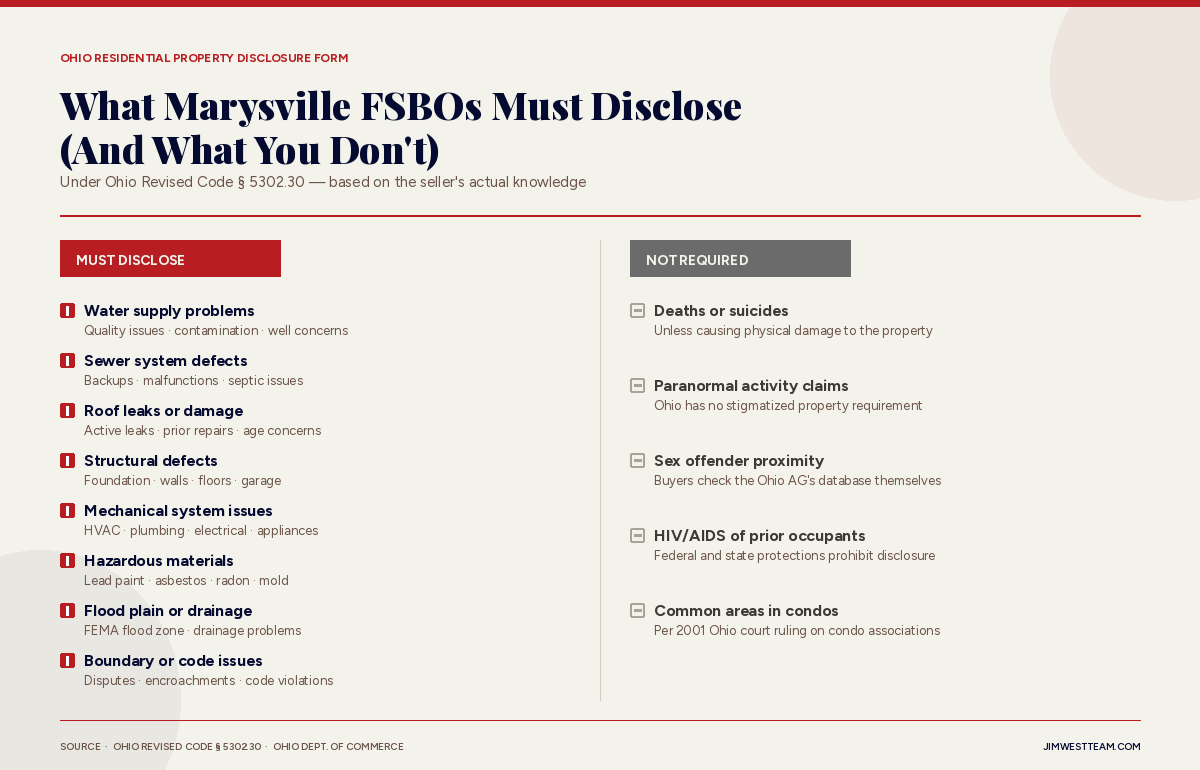
The Ohio Residential Property Disclosure Form is organized into roughly a dozen categories. As a FSBO, you'll need to answer questions in each area based on what you know:
- Water supply — source (public, well, cistern), any quality issues, any history of contamination
- Sewer system — public sewer, septic tank, aeration system, any backups or malfunctions
- Roof — age, any leaks, prior repairs, current condition
- Water intrusion — basement seepage, foundation leaks, prior water damage
- Structural components — foundation, floors, walls, ceilings, garage
- Mechanical systems — electrical, plumbing, HVAC, water heater, appliances
- Wood-destroying insects — termites, carpenter ants, prior treatments
- Hazardous materials — lead-based paint, asbestos, radon, mold, urea-formaldehyde insulation
- Underground storage tanks — fuel oil tanks, removed or active
- Flood plain and drainage — FEMA flood zone designation, drainage problems
- Zoning and code violations — any known violations or unresolved building permits
- Boundary disputes and encroachments — fences, sheds, easements affecting use
- Assessments and HOA fees — recent or proposed special assessments, HOA dues
Each section gives you space to explain. "Yes, I know about it" requires a description. "No, I don't know" is a valid answer. "I don't know" is also valid — but only when it's actually true.
What You DON'T Have to Disclose
Ohio law is specific about what's not required on the disclosure form. You are not obligated to disclose:
- Deaths, suicides, or violent crimes that occurred on the property — unless they caused physical damage to the structure (biohazard contamination, structural damage)
- Beliefs about paranormal activity or hauntings — Ohio has no "stigmatized property" disclosure requirement
- Proximity to registered sex offenders — buyers are responsible for checking the Ohio Attorney General's database themselves
- The HIV/AIDS status of any previous occupant
- Defects in common areas of condominiums (per a 2001 court ruling)
This doesn't mean you can hide a death that affected the property's value. It means you have no legal obligation to volunteer the information — but if a buyer asks directly, lying creates exposure. Silence is legal. Lying is not.
The Federal Lead-Based Paint Disclosure (A Separate Requirement)
If your Marysville home was built before 1978, you have a second mandatory disclosure on top of the Ohio form — this one federal.
The Lead-Based Paint Hazard Reduction Act of 1992 requires sellers of pre-1978 homes to:
- Provide the buyer with the EPA-approved pamphlet, Protect Your Family From Lead in Your Home
- Include a specific Lead Warning Statement in the purchase contract
- Disclose any known lead-based paint or lead-paint hazards in the home
- Provide any available records or reports about lead in the property
- Allow the buyer a 10-day period to conduct a lead-paint risk assessment
Marysville has a meaningful number of pre-1978 homes — older homes near downtown, on properties closer to Plain City, and in rural Union County. If your home falls in that category, the federal disclosure is non-negotiable and separate from the Ohio form. Skipping it can result in federal penalties up to $19,000 per violation plus treble damages in civil suits.
The "As-Is" Trap
This catches more FSBOs than any other single misunderstanding:
Selling your home "as-is" does NOT waive your disclosure obligation.
"As-is" means the buyer accepts the property in its current condition and you won't make repairs. It does not mean the buyer waives their right to know about defects you already know about. The disclosure form still applies. The buyer still has rescission rights if you fail to disclose a known material defect.
If you intend to sell as-is, you actually need to be more thorough on the disclosure form, not less — because an as-is buyer who later discovers a hidden defect has even more reason to argue you knew about it and deliberately failed to disclose.
Ashmus v. Coughlin (2025): What the Ohio Supreme Court Just Clarified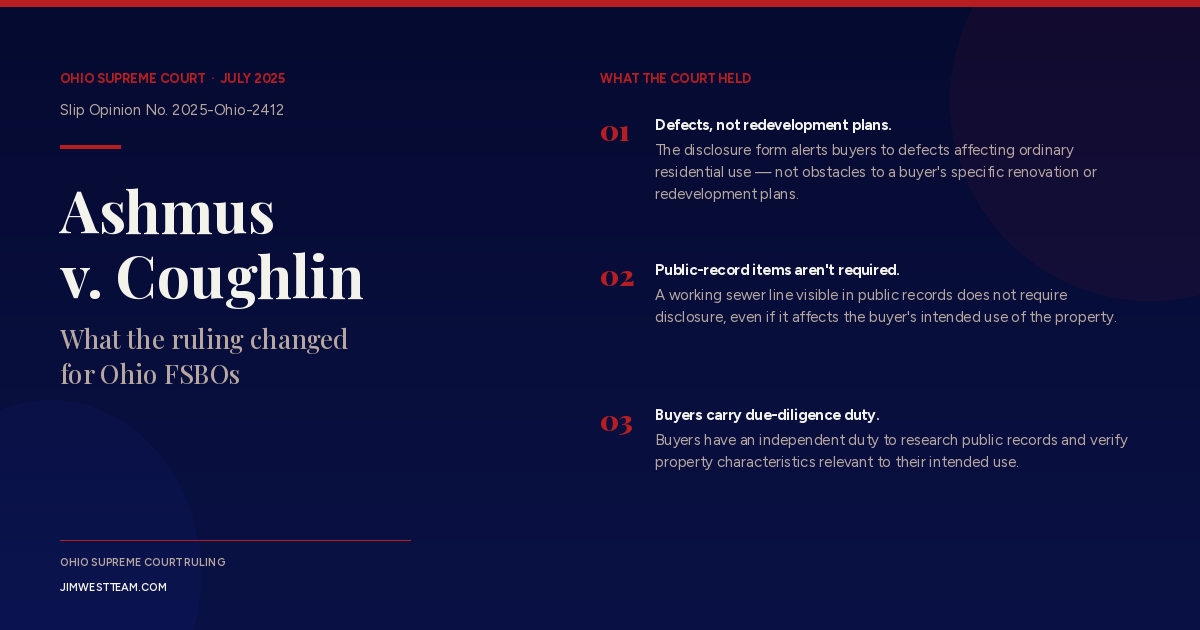
In July 2025, the Ohio Supreme Court ruled in Ashmus v. Coughlin (Slip Opinion No. 2025-Ohio-2412) on the scope of seller disclosure obligations. The case involved buyers who planned to demolish a lakefront home and rebuild — they later discovered a sewer line running through the property that interfered with their construction plans, and they sued the seller for failure to disclose.
The Court ruled in favor of the seller, holding that:
- The disclosure form is intended to alert buyers to defects that affect ordinary residential use, not obstacles to specific redevelopment plans
- A working sewer line visible in public records does not require disclosure, even if it affects the buyer's intended use
- Buyers have a duty to perform their own due diligence on matters of public record
What this means for Marysville FSBOs: the disclosure form is about defects affecting the home as a home. You're not legally obligated to disclose every utility easement, recorded covenant, or zoning quirk that a buyer could find through standard public records research. But the safer practice is to over-disclose when in doubt — the Ashmus ruling defends sellers who didn't disclose public-record items, but it doesn't reward sellers who deliberately concealed them.
The Rescission Right (And Why It's Expensive)
Here's the part that should get every FSBO's attention.
If you fail to deliver the disclosure form before the buyer signs the purchase agreement, the buyer has a statutory right to rescind the contract — meaning they can walk away with their earnest money and you have no recourse. This right can be exercised up to three business days after they receive the form or three business days after the purchase agreement is signed, whichever is later.
If you delivered the form but failed to disclose a known material defect, the consequences can be worse:
- The buyer may rescind the transaction even after closing under certain conditions
- The buyer can sue for damages — including the cost to repair the undisclosed defect, diminished property value, and in some cases, punitive damages
- The buyer can claim fraud or misrepresentation, which can pierce common contract defenses like "as-is" clauses
- You may be responsible for the buyer's attorney's fees
The math is brutal. If you sell a $400,000 Marysville home and later get sued for failing to disclose a $25,000 foundation issue you knew about, you're looking at potential rescission of a closed sale, $25,000 in repair damages, possible punitive damages, the buyer's legal fees, and your own legal defense costs. The total exposure can easily exceed the commission savings that drove you to FSBO in the first place.
5 Practical Tips for Filling Out the Disclosure Form Correctly
- Don't rush it. The form takes 30-60 minutes to complete carefully. Read every question. If you're unsure how to answer, that's a signal to think about it longer, not to mark "I don't know" reflexively.
- Pull your records first. Gather receipts, warranties, prior inspection reports, contractor invoices, and HOA documents before you start. Anything you actually know is something you must disclose.
- When in doubt, disclose. The legal risk of over-disclosing is essentially zero. The legal risk of under-disclosing is significant. If you think a buyer might reasonably want to know something, write it down.
- Be specific in your descriptions. "Roof leaked in 2022 after the March hail storm. Repaired by Smith Roofing for $4,200 — receipt attached. No leaks since." That's a defensible disclosure. "Some past roof issues, repaired." is not.
- Have a real estate attorney review it. This is the single best $200-$400 you can spend as a FSBO. An attorney can spot ambiguous language, ensure you've addressed everything material, and reduce your post-closing exposure dramatically.
Where to Get the Form
The current Ohio Residential Property Disclosure Form (June 2022 version) is available from the Ohio Department of Commerce, Division of Real Estate. Don't use an older version you found on a forum or template site — the form has been updated multiple times over the years, and using an outdated version creates compliance gaps.
Download it directly from com.ohio.gov or from Ohio REALTORS®.
Frequently Asked Questions
Can a Marysville FSBO sell a home in Ohio without using the Ohio Residential Property Disclosure Form?
Only if the transaction falls into one of the statutory exemptions under ORC § 5302.30 — for example, transfers between immediate family members, transfers ordered by a court, or sales of newly built homes that have never been occupied. For a typical FSBO sale to an unrelated buyer, the disclosure form is mandatory.
What happens if I sell my Marysville home "as-is" — do I still need to disclose?
Yes. Selling "as-is" means the buyer accepts the property's current condition and you won't make repairs. It does not waive your disclosure obligation under Ohio law. The buyer still has the right to receive the Residential Property Disclosure Form and the right to rescind if you fail to deliver it or fail to disclose known material defects.
Do I have to disclose a death that occurred in my Marysville home?
Not unless the death caused physical damage to the property (biohazard contamination, structural damage). Ohio has no "stigmatized property" disclosure requirement. However, if a buyer asks directly, you cannot lie — silence is legal, deception is not.
How long is the buyer's rescission window in Ohio?
If you fail to deliver the disclosure form before the buyer signs the purchase agreement, the buyer can rescind up to three business days after receiving the form or three business days after the purchase agreement is signed — whichever is later. If you deliver the form but a material defect is later discovered that you knew about and didn't disclose, the buyer may have grounds to rescind even after closing, depending on the circumstances.
Do I need a lawyer to fill out the Ohio Residential Property Disclosure Form?
Not legally required, but strongly recommended for FSBOs. A real estate attorney typically charges $200-$400 to review the completed form and your draft purchase agreement. That's the cheapest insurance policy you can buy against a post-closing lawsuit. Given that even one undisclosed material defect can expose you to damages in the tens of thousands of dollars, attorney review is one of the highest-ROI expenses in any FSBO transaction.
Want a Second Pair of Eyes Before You List?
Compliance is the part of FSBO selling that costs people money long after the sale closes. If you want a no-cost, no-pitch conversation about what you'll need to disclose on your Marysville or Union County home before you list, I'm happy to walk through it with you. I won't replace an attorney — that's not what I do — but I can tell you what to look out for, what most FSBOs miss, and what's worth flagging on the form.
Call or text Jim West at (614) 507-5732 or visit jimwestteam.com.
For the complete FSBO resource library — pricing guides, document checklists, and compliance walkthroughs — see the Marysville FSBO Guide. If you're specifically wondering whether your price is right, start with How to Price Your FSBO Home in Marysville.
This article provides general information about Ohio's residential disclosure requirements and is not legal advice. Disclosure obligations depend on the specific facts of each transaction. Marysville and Union County FSBOs facing uncertainty about their disclosure obligations should consult a licensed Ohio real estate attorney before completing the Residential Property Disclosure Form.
— Jim West
REALTOR® | Certified Divorce Real Estate Expert (CDRE)
Jim West Team
Marysville, Ohio & Union County
(614) 507-5732
jimwest@jimwestteam.com
jimwestteam.com