

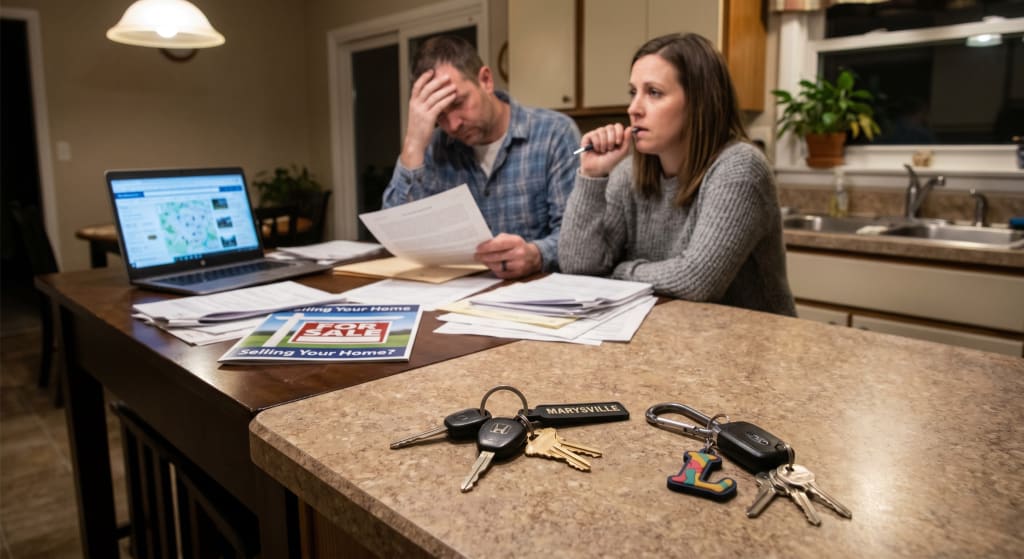

Should you sell your home before or after your Ohio divorce is final? In most cases, selling before the divorce is final lets a married couple keep the full $500,000 federal capital gains exclusion on a joint return — but timing depends on your equity, your taxes, and how well the two of you can cooperate.
It is one of the first practical questions divorcing homeowners in Marysville and across Union County ask me: do we sell the house now, or wait until everything is signed? There is no single right answer. But there are a handful of factors that almost always decide it, and getting them in the right order can mean tens of thousands of dollars and a lot less friction.
I am a Certified Divorce Real Estate Expert (CDRE), which means I work specifically with couples navigating the sale of a jointly owned home during a divorce. What follows is what I walk clients through. None of it is legal or tax advice — those calls belong to your attorney and your CPA — but it should help you ask the right questions.
The Tax Factor: Why Timing Can Be Worth Real Money
The biggest financial reason to think carefully about timing is the federal capital gains exclusion under IRS Section 121.
Here is the short version. When you sell your primary residence, you can exclude a portion of your profit from capital gains tax:
- $250,000 of gain if you file as a single person
- $500,000 of gain if you are married and file a joint return
To qualify, you generally must have owned and lived in the home for at least two of the five years before the sale. The catch for divorcing couples is the filing status. To claim the full $500,000, you typically need to still be married and filing jointly in the year you sell.
Selling While Still Married
If your home has appreciated significantly — and many Marysville homes bought before 2020 have — selling while you are still legally married and able to file jointly preserves that $500,000 shield. For couples sitting on $300,000 or $400,000 of equity, that single decision can erase a tax bill entirely.
Selling After the Divorce Is Final
Once you are divorced, each of you files as a single person and gets a $250,000 exclusion — which adds up to the same $500,000 on paper. The risk is whether each spouse still qualifies. The spouse who moved out years earlier can fail the two-year use test, and a home with large gains may need the full exclusion on one return. There are special divorce-related rules that can help, but they are technical, and this is exactly the conversation to have with a tax professional before you list.
The Equity Factor: Cash Now vs. a Cleaner Split Later
Selling before the divorce is final means the proceeds usually go into one pot to be divided as part of the settlement. Ohio is an equitable distribution state, which means marital property is divided fairly — not always 50/50. Selling early can simplify that math: instead of arguing over what the house is "worth," you have an actual number from an actual buyer.
I had a young couple in Mill Valley who spent about three months stuck on list price, mostly because they each pointed to a different Zillow number. Every month they argued, they kept burning through savings, court costs, and attorney fees. It took a court directing them to agree on a Realtor to break the logjam. They both knew me and trusted me to be fair to each of them, and after a few honest conversations about the real comparable sales, we landed on a price they could both live with. The house sold. The arguing stopped.
Waiting until after the divorce is final can make sense when one spouse wants the chance to buy the other out, when there are children whose school year you would rather not disrupt mid-sale, or when the market timing favors a specific season. (If you are weighing a buyout instead of a sale, that is its own decision — and one I cover in my Divorce Home Sales Guide.)
The Cooperation Factor: The One That Decides Most Cases
Honestly, the tax and equity questions are often settled by a more basic reality: how well can the two of you work together right now?
Selling a home takes a steady stream of joint decisions — list price, repairs, showings, which offer to accept, what to counter. If you and your spouse can stay in the same room on those calls, selling before the divorce is final is usually faster and cheaper. If every conversation turns into a standoff, it is often better to let the court establish the framework first, or to bring in a neutral third party who answers to both of you rather than to one side.
That neutrality is the core of what a CDRE does differently. I am not there to get one spouse the best deal at the other's expense. I am there to get the house sold for the most money, on terms the court and both attorneys can sign off on, with documentation that holds up. You can read more about what a CDRE is and how the role works if you want the full picture.
A Simple Way to Think About It
When clients ask me to boil it down, here is the order I suggest:
- Talk to your attorney and CPA about the tax exclusion first. If a large capital gain is in play, the answer often leans toward selling while you can still file jointly.
- Be honest about cooperation. If the two of you cannot make joint decisions without conflict, build that into the plan — either by selling under a court framework or by using a neutral CDRE.
- Then weigh equity and life logistics. Kids, school years, buyout interest, and market season are real, but they usually come after the tax and cooperation questions.
Every divorce is different, and the right move for a couple in Mill Valley with $400,000 of equity is not the same as the right move for a couple in a starter home off Route 33. The point is to make the decision deliberately — not by default because no one wanted to bring it up.
Frequently Asked Questions
Can I sell my house during a divorce in Ohio?
Yes. Couples sell jointly owned homes during an active divorce all the time in Ohio. Both spouses typically need to agree to the sale and sign the listing and closing documents, and the proceeds are usually held and divided as part of the settlement. If one spouse refuses to cooperate, the court can become involved.
Do we have to sell the house, or can one spouse keep it?
You are not required to sell. One spouse can buy out the other's share, often by refinancing the mortgage into their own name and paying the departing spouse their portion of the equity. Whether a buyout or a sale makes more sense depends on each person's finances and what the settlement calls for.
What is a Certified Divorce Real Estate Expert (CDRE)?
A CDRE is a real estate professional with specialized training in handling home sales tied to divorce. The role emphasizes neutrality, accurate valuation, and clear documentation that satisfies both attorneys and the court. Jim West is one of the few agents in Union County, Ohio who holds this designation.
Talk It Through With Someone Who Has Done This Before
If you or someone you know owns a home and is going through a divorce in Ohio, I am one of the few agents in Union County who holds the Certified Divorce Real Estate Expert (CDRE) designation. I understand the legal, financial, and emotional complexity of this situation — and I am a resource, not a salesperson. Call or text me at (614) 507-5732, or learn more on my Union County divorce real estate page.
Jim West
REALTOR® | Certified Divorce Real Estate Expert (CDRE)
Jim West Team — Marysville, Ohio & Union County
(614) 507-5732 | jimwestteam.com
This article is for general information only and is not legal or tax advice. Property division and tax outcomes vary by situation. Consult your divorce attorney and a qualified tax professional before making decisions about selling your home.