The Quit Claim Deed Trap: Why Divorcing Homeowners Must Avoid This Common Mistake
Jim West
The Hidden Dangers of Quit Claim Deeds in Divorce | Jim West CDRE Marysville Ohio
The Quit Claim Deed Trap: Why Divorcing Homeowners Must Avoid This Common Mistake
You're sitting in your attorney's office, emotionally exhausted from months of divorce proceedings. The property settlement seems straightforward: your spouse gets the house, and you're ready to move on with your life. Your attorney slides a quit claim deed across the desk. "Just sign here, and the house is out of your name," they say. It sounds simple. It sounds final. It sounds like closure.
But signing that quit claim deed could be one of the most financially devastating decisions of your entire divorce.
As a Certified Divorce Real Estate Expert (CDRE) serving Marysville and Central Ohio for over 20 years, I've watched countless divorcing homeowners make this mistake, only to discover the nightmare consequences months or even years later. Today, I'm going to explain exactly why quit claim deeds are dangerous in divorce situations and what you should do instead.
What Is a Quit Claim Deed?
A quit claim deed is a legal document that transfers one person's ownership interest in a property to another person. When you sign a quit claim deed, you're essentially saying, "I'm giving up any claim I have to this property." The transfer is immediate, and there's no going back.
In divorce situations, quit claim deeds are commonly used when one spouse is awarded the marital home in the settlement agreement. The spouse who's leaving signs the quit claim deed, transferring their ownership interest to the spouse who's keeping the house. On the surface, this seems like a clean, simple solution.
But there's a critical problem that most people don't understand until it's too late.
The Critical Flaw: Title vs. Mortgage Liability
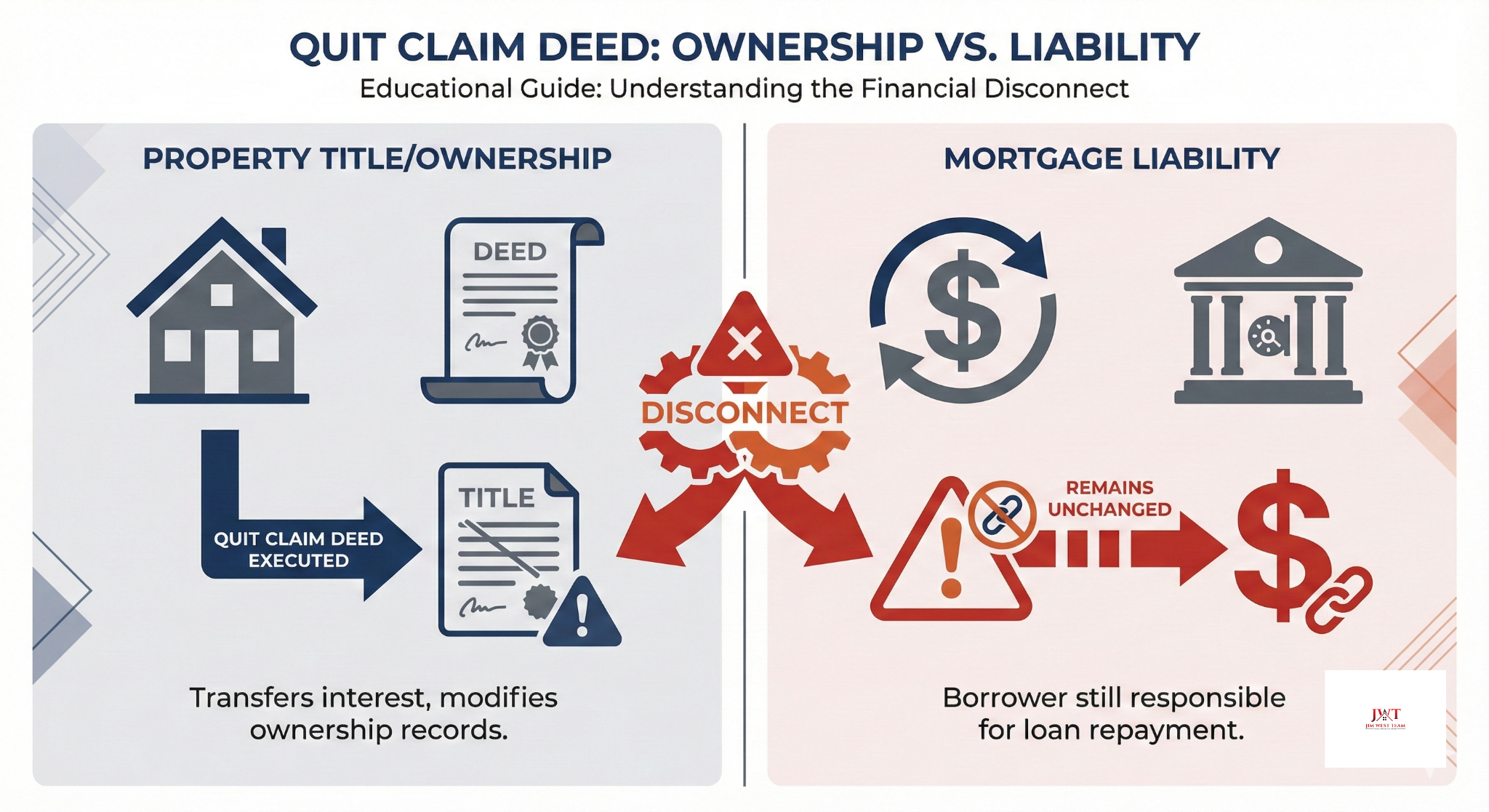
Understanding the critical difference between title ownership and mortgage liability
Here's what your divorce attorney may not have clearly explained: removing your name from the property title does NOT remove your name from the mortgage.
These are two completely separate legal documents:
The deed/title determines who owns the property
The mortgage determines who is legally obligated to pay the loan
When you sign a quit claim deed, you're only addressing the title. You're giving up your ownership rights to the property. But you're not released from your obligation to pay the mortgage debt. If both of your names were on the original mortgage (which is common for married couples), you remain 100% responsible for that debt even after you've signed away your ownership interest.
Let That Sink In for a Moment
You no longer own the house. You have zero ownership rights. You can't live there. You can't sell it. You can't access any equity. But you're still fully liable for paying the mortgage. Every single month.
The Nightmare Scenarios That Happen Next
I wish I could tell you that most divorcing spouses who keep the house faithfully make every mortgage payment on time. Unfortunately, life after divorce is complicated, and financial circumstances change. Here are the devastating scenarios I've seen play out:
Scenario 1: Your Ex-Spouse Stops Making Payments
Your credit score plummets when your ex stops making mortgage payments
This is the most common nightmare. Your ex-spouse, who now owns the house, experiences financial difficulties. Maybe they lose their job. Maybe they simply decide they can't afford the house. Maybe they're angry about the divorce and want to punish you. Whatever the reason, they stop making mortgage payments.
And guess whose credit gets destroyed?
Yours does. Because your name is still on that mortgage, every missed payment appears on your credit report. The late payments, the default notices, the eventual foreclosure—all of it damages your credit score just as severely as if you were the one living in the house and missing payments.
Scenario 2: You Can't Buy Another Home
You've moved on with your life. You've met someone new. You're ready to buy a house and start fresh. But when you apply for a mortgage, you discover a problem: you already have a mortgage in your name. That mortgage on your ex-spouse's house counts against your debt-to-income ratio, even though you don't live there and have no ownership rights.
This existing mortgage obligation can prevent you from qualifying for a new home loan, or it might mean you qualify for far less than you need. I've watched clients realize, years after their divorce, that they're trapped in rental properties or unable to move forward with their lives because of a quit claim deed they signed during an emotionally vulnerable moment.
Scenario 3: The Foreclosure That Destroys Your Future
If your ex-spouse stops making payments and the house goes into foreclosure, the lender will come after both of you for the deficiency (the difference between what the house sells for at foreclosure and what's owed on the mortgage). You could face:
A foreclosure on your credit report (stays for 7 years)
A deficiency judgment and potential lawsuit
Wage garnishment to collect the debt
Inability to qualify for any mortgage for several years
Severely damaged credit affecting employment, insurance rates, and rental applications
And here's the cruelest part: even though you no longer own the house, you have no legal right to protect your investment. You can't force a sale. You can't force your ex-spouse to make payments. You can't even access the property to maintain it or market it if foreclosure is imminent. You're stuck with all the financial liability and none of the control.
Scenario 4: Your Divorce Decree Offers No Real Protection
Many people mistakenly believe that if their divorce decree states that their ex-spouse is responsible for the mortgage, they're protected. Let me be crystal clear: your divorce decree is not binding on your mortgage lender.
The divorce decree is an agreement between you and your ex-spouse. Your mortgage is a contract between both of you and the bank. The bank didn't sign your divorce decree and isn't bound by its terms. If your ex-spouse stops paying, the lender will pursue both of you, regardless of what your divorce papers say.
Yes, you could potentially sue your ex-spouse for violating the divorce decree, but that requires hiring an attorney, going back to court, and trying to collect money from someone who's already proven they can't or won't pay. Meanwhile, your credit is being destroyed in real-time.
Why Do Divorce Attorneys Recommend Quit Claim Deeds?
If quit claim deeds are so problematic, why do divorce attorneys frequently recommend them? The answer is frustrating but important to understand:
Because they're easy and cheap.
Divorce attorneys are experts in family law, not real estate or mortgage financing. For them, a quit claim deed efficiently addresses the ownership issue in the divorce settlement. It's a simple document that cleanly transfers title from one spouse to another. It doesn't require lender approval, refinancing, or complex coordination with real estate professionals.
Many divorce attorneys simply don't fully understand the mortgage liability implications, or they assume it's not their responsibility to address those financial concerns. They're focused on finalizing the divorce decree and moving to their next case.
Additionally, some attorneys know that properly handling the property situation will require refinancing, which means the divorce can't be finalized until that refinancing is complete. If the spouse keeping the house can't qualify for refinancing, the house may need to be sold, which extends the divorce timeline and creates additional complications. The quit claim deed allows the divorce to be finalized quickly, even though it creates a financial time bomb for the future.
The Right Way to Handle Property in Divorce
Working with a CDRE ensures property is handled correctly from the start
So what should you do instead? Here are the proper options for handling real estate in divorce, ranked from best to most challenging:
Option 1: Sell the House and Split the Proceeds (The Gold Standard)
If possible, this is usually the cleanest solution. Selling the marital home during or immediately after divorce accomplishes several critical objectives:
Both spouses are released from mortgage liability
Equity is divided according to the settlement agreement
Both parties can move forward with clean credit and no lingering financial entanglements
There's no risk of one spouse damaging the other's credit in the future
Both people can qualify for new mortgages without the existing loan on their records
As someone who has guided hundreds of divorcing couples through property sales, I can tell you that while selling during divorce is emotionally difficult, it's often the wisest long-term decision. The clean financial break allows both parties to rebuild their lives without the ongoing stress and risk of continued property co-ownership.
Option 2: Refinance to Remove One Spouse from the Mortgage
If one spouse genuinely wants to keep the house and can afford it, the proper solution is refinancing. The spouse keeping the property must:
Qualify for a new mortgage in their name only, based on their individual income and credit
Have sufficient income to afford the mortgage payment without their ex-spouse's income
Refinance the existing mortgage, which releases the departing spouse from all liability
Buy out their ex-spouse's equity share, either through the refinance or a separate payment
Only after the refinance is complete should the departing spouse sign a quit claim deed transferring title. This way, when you sign away your ownership interest, you're simultaneously released from the mortgage debt.
The challenge with this option is that many spouses who want to keep the house discover they cannot qualify for a refinance on their own. In today's interest rate environment, qualifying for a mortgage on a single income is even more difficult. The home that was affordable on two incomes may be completely out of reach on one income, especially when you factor in higher interest rates compared to your original mortgage.
Option 3: Assumption with Lender Release (Rare But Valuable)
Some mortgages, particularly FHA and VA loans, are assumable. This means your spouse might be able to assume the existing mortgage in their name only, provided they qualify with the lender. If your lender agrees to release you from liability as part of the assumption process, this can be a good solution.
However, true release from liability on an assumption is rare and requires the lender's explicit approval. The assuming spouse must qualify based on their individual income and credit, and the lender must formally agree to release the non-assuming spouse from the obligation.
Never assume you're released simply because your spouse has "assumed" the payments. Get written confirmation from the lender.
Option 4: Delayed Sale with Legal Protections (When You Have No Choice)
Sometimes circumstances require keeping the house jointly owned for a limited period—perhaps until children graduate from high school or until market conditions improve. If you absolutely must remain on the mortgage temporarily, implement these protections:
Set a firm deadline for sale or refinance in your divorce decree (e.g., "Property must be sold or refinanced within 24 months")
Require verification of payment each month (such as requiring the paying spouse to provide mortgage statements)
Maintain access to mortgage account information online so you can monitor payments in real-time
Include specific remedies in the divorce decree if payments are missed (such as automatic listing for sale after one missed payment)
Require life insurance on the spouse keeping the house, with you as beneficiary, to cover the mortgage if they pass away
Consider professional property management if you're leaving someone in the house who has a history of poor financial management
Even with all these protections, understand that you're still at risk. Your credit is still tied to your ex-spouse's financial behavior. This should be a temporary situation only, with a clear exit strategy and firm deadline.
What If You've Already Signed a Quit Claim Deed?
If you're reading this and realizing you've already signed a quit claim deed without addressing the mortgage, don't panic. You have options, though they require immediate action:
Short-Term Actions:
Monitor the mortgage religiously - Set up online access immediately (if you don't already have it) so you can check payment status
Pull your credit report monthly - Use a free service to monitor for any missed payments appearing on your credit
Set up payment alerts - Many mortgage servicers allow you to set up text or email alerts when payments are made or missed
Document everything - Save all evidence of your ex-spouse's payment history
Long-Term Solutions:
Push for immediate refinancing - Work with your attorney to pressure your ex-spouse to refinance immediately, even if that wasn't specified in the original decree
Consider legal action - If your ex-spouse is violating terms of your divorce decree, return to court to enforce the agreement
Force a sale - If refinancing isn't possible and you're at risk, your attorney may be able to petition the court to order a sale of the property
Make the payments yourself if necessary - If your ex stops paying and you can't force a sale quickly, consider making payments to protect your credit, then suing for reimbursement
The key is acting immediately rather than hoping your ex-spouse will continue making payments. By the time you discover missed payments on your credit report, the damage is already done.
Red Flags That Your Attorney Doesn't Understand Real Estate
During your divorce, watch for these warning signs that your attorney may not fully grasp the real estate implications:
They suggest a quit claim deed without discussing mortgage refinancing or sale
They say "the divorce decree protects you" regarding the mortgage
They don't seem concerned that the spouse keeping the house hasn't been pre-approved for refinancing
They're unfamiliar with concepts like debt-to-income ratios, assumable mortgages, or lender release requirements
They want to finalize the divorce quickly without addressing how mortgage liability will be handled
They dismiss your concerns about future credit implications
If you notice these red flags, it's time to bring in additional expertise. A Certified Divorce Real Estate Expert (CDRE) can work alongside your attorney to ensure the real estate aspects of your divorce are handled properly.
How a CDRE Can Protect You
Expert CDRE guidance protects your financial future during divorce
This is exactly why the Certified Divorce Real Estate Expert (CDRE) designation exists. As a CDRE serving Central Ohio, I work with divorcing homeowners and their attorneys to navigate these complex situations. Here's how I can help:
Property Valuation and Equity Assessment
Before any decisions are made, we need to know exactly what your property is worth and how much equity exists. I'll provide a comprehensive market analysis that shows:
Negotiation of offers to maximize your net proceeds
Coordination with your attorney to ensure the sale proceeds are distributed according to your settlement agreement
Coordination with Legal Professionals
I regularly work directly with divorce attorneys to ensure the property aspects of divorce decrees are structured properly. This includes:
Reviewing proposed settlement language to identify potential problems
Suggesting specific timelines and benchmarks for property disposition
Providing market data that helps negotiate fair property settlements
Attending mediation sessions when property issues are complex
Emotional Support and Objective Guidance
Divorce is emotionally exhausting, and property decisions are often clouded by emotion. As a neutral real estate professional, I can provide objective guidance that keeps your long-term financial interests at the forefront. I've worked with hundreds of divorcing couples and can anticipate problems before they arise.
The Bottom Line on Quit Claim Deeds
Let me be absolutely clear: signing a quit claim deed before addressing mortgage liability is financial suicide. It's giving up all your rights while keeping all your responsibilities. It's the worst of both worlds.
If your attorney suggests a quit claim deed, ask these specific questions:
"How will my name be removed from the mortgage?"
"What happens to my credit if my ex-spouse stops making payments?"
"Can I qualify for a new mortgage while this existing mortgage is still in my name?"
"What recourse do I have if the house goes into foreclosure?"
"Should we require proof of refinancing or sale before finalizing the divorce?"
If your attorney doesn't have clear, confident answers to these questions, insist on bringing in a real estate professional who specializes in divorce situations.
Real-Life Success Stories: Doing It Right
Let me share a few examples from my practice where we avoided the quit claim deed trap:
The Couple Who Sold First
Sarah and Mike were divorcing after 12 years of marriage. Sarah wanted to keep the house where their kids had grown up, but when we ran the numbers, she couldn't qualify for refinancing on her teacher's salary. Initially, she was devastated. Her attorney had already drafted a quit claim deed for Mike to sign.
I explained the risks to both of them. We listed the house, and it sold for $45,000 more than their original mortgage balance. After splitting the proceeds, Sarah had enough for a down payment on a smaller, more affordable home that she qualified for on her own income. Mike was able to buy a condo without his credit being tied to Sarah's financial decisions.
Five years later, both have excellent credit, have remarried, and are thriving financially. If Sarah had kept the house with Mike still on the mortgage, it would have been a disaster for both of them.
The Refinance That Saved a Family
Tom wanted to keep the family home but couldn't qualify for traditional refinancing. Working with a skilled mortgage professional, we discovered that he qualified for an FHA loan with his current income. We coordinated the refinancing before the divorce was finalized. Once Tom's refinance closed and his ex-wife was officially off the mortgage, she signed the quit claim deed.
The refinance cost Tom about $4,000 in closing costs and raised his interest rate by 1.5%, which increased his payment by $300 per month. But it was worth it to both of them to have a clean financial break. His ex-wife was able to buy her own home six months later without the old mortgage affecting her debt-to-income ratio.
The Strategic Sale That Captured Market Equity
Jennifer and David were divorcing in a challenging situation: their home value had declined since they purchased it, and they were slightly underwater on their mortgage. Their attorney was suggesting that Jennifer do a quit claim deed and David keep making payments until the market recovered.
I explained that this could leave Jennifer vulnerable for years. We explored a strategic short sale where the bank agreed to accept less than the full mortgage balance. Both Jennifer and David's credit was impacted, but both were released from the mortgage obligation. They negotiated to split the credit hit equally rather than leaving Jennifer exposed indefinitely.
Within three years, both had recovered their credit enough to qualify for new mortgages. If Jennifer had signed that quit claim deed, she could have been tied to that underwater mortgage for a decade or more if David had encountered financial problems.
Take Action Now
If you're currently going through a divorce in Marysville or anywhere in Central Ohio, don't make the quit claim deed mistake. Here's what to do:
Schedule a confidential consultation with me to discuss your property situation. We'll review your mortgage, equity position, and realistic options for handling the property correctly.
Get pre-approved for refinancing if you want to keep the house, or have your spouse get pre-approved. Know whether refinancing is even possible before making commitments in your divorce decree.
Consider selling and making a clean break. It's emotionally difficult, but financially it's often the wisest choice.
Involve a CDRE early in your divorce process, ideally before settlement negotiations begin. The earlier I'm involved, the more options we have to protect your interests.
Never sign a quit claim deed without addressing mortgage liability first. Period.
Your future financial security is too important to leave to chance or to rush through because you're emotionally exhausted from the divorce process. Take the time to handle your real estate situation properly. Your future self will thank you.
Contact a Certified Divorce Real Estate Expert
As a CDRE with over 20 years of experience in Central Ohio, I've guided hundreds of divorcing homeowners through these challenging decisions. I understand the emotional complexity of divorce, and I'm committed to protecting your financial interests during this difficult transition.
Don't let a quit claim deed destroy your credit and financial future. Let's discuss your specific situation and develop a strategy that protects you.
Your divorce is temporary. The financial consequences of a quit claim deed can last for decades. Let's make sure your property situation is handled correctly from the beginning.
Facing Divorce and Unsure About Your Home?
Download my free guide: "The Complete Guide to Selling Your Home During Divorce" for detailed information about all your options, timelines, and strategies for protecting your interests.